

Connexion client
Connexion
S'inscrire
Créer un compte a de nombreux avantages :
- Voir la commande et suivre l'expédition
- Suivre l'historique des commandes
- Commander plus rapidement
Mon panier
Sous-total du panier
x
Montant :
Gratuit
Un ou plusieurs articles de votre panier nécessitent une prescription. Vous pouvez soumettre les détails de la (des) prescription(s) sur la page du panier.
Passer à la caisse
Voir et éditer le panier
Aucun article dans votre panier.
Langues
Google Translate :
Efient Comp Pell 28 X 5mg
Sur prescription
Médicament
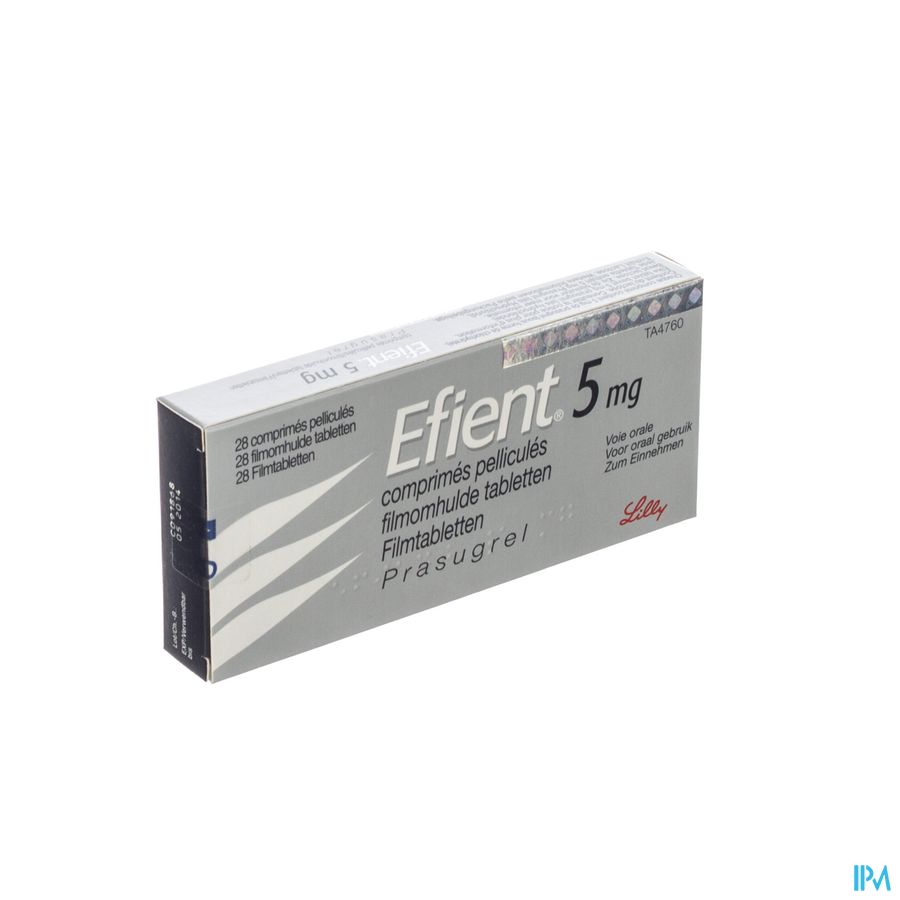
Efient Comp Pell 28 X 5mg
Sur prescription
Médicament
28,82 €
Prix Habituel
éligibles au remboursement
Si vous avez droit au remboursement de ce médicament, vous paierez le taux de remboursement en pharmacie et non le prix affiché sur notre webshop.
Prix avec remboursement standard
Vous payez : € 7,44 (6% TVA incluse)
Prix avec remboursement majoré
Vous payez : € 4,42 (6% TVA incluse)
Ce produit doit être approuvé par le pharmacien. Cela peut prendre un certain temps.
Informations importantes
Ce médicament nécessite une ordonnance valide. Il ne peut pas être acheté en ligne et doit être payé à la pharmacie après examen par le pharmacien.
28,82 €
Prix Habituel
Sur demande
Chargement en cours...
4.4 Special warnings and precautions for use Bleeding risk In the phase 3 clinical trial (TRITON) key exclusion criteria included an increased risk of bleeding; anaemia; thrombocytopaenia; a history of pathological intracranial findings. Patients with acute coronary syndromes undergoing PCI treated with Efient and ASA showed an increased risk of major and minor bleeding according to the TIMI classification system. Therefore, the use of Efient in patients at increased risk of bleeding should only be considered when the benefits in terms of prevention of ischaemic events are deemed to outweigh the risk of serious bleedings. This concern applies especially to patients: • ≥ 75 years of age (see below). • with a propensity to bleed (e.g. due to recent trauma, recent surgery, recent or recurrent gastrointestinal bleeding, or active peptic ulcer disease) • with body weight < 60 kg (see sections 4.2 and 4.8). In these patients the 10 mg maintenance dose is not recommended. A 5 mg maintenance dose should be used. • with concomitant administration of medicinal products that may increase the risk of bleeding, including oral anticoagulants, clopidogrel, non-steroidal anti-inflammatory drugs (NSAIDs), and fibrinolytics. For patients with active bleeding for whom reversal of the pharmacological effects of Efient is required, platelet transfusion may be appropriate. The use of Efient in patients ≥ 75 years of age is generally not recommended and should only be undertaken with caution after a careful individual benefit/risk evaluation by the prescribing physician indicates that benefits in terms of prevention of ischaemic events outweigh the risk of serious bleedings. In the phase 3 clinical trial these patients were at greater risk of bleeding, including fatal bleeding, compared to patients < 75 years of age. If prescribed, a lower maintenance dose of 5 mg should be used; the 10 mg maintenance dose is not recommended (see sections 4.2 and 4.8). Therapeutic experience with prasugrel is limited in patients with renal impairment (including ESRD) and in patients with moderate hepatic impairment. These patients may have an increased bleeding risk. Therefore, prasugrel should be used with caution in these patients. Patients should be told that it might take longer than usual to stop bleeding when they take prasugrel (in combination with ASA), and that they should report any unusual bleeding (site or duration) to their physician. Bleeding Risk Associated with Timing of Loading Dose in NSTEMI In a clinical trial of NSTEMI patients (the ACCOAST study), where patients were scheduled to undergo coronary angiography within 2 to 48 hours after randomization, a prasugrel loading dose given on average 4 hours prior to coronary angiography increased the risk of major and minor peri-procedural bleeding compared with a prasugrel loading dose at the time of PCI. Therefore, in UA/NSTEMI patients, where coronary angiography is performed within 48 hours after admission, the loading dose should be given at the time of PCI (see sections 4.2, 4.8 and 5.1). Surgery Patients should be advised to inform physicians and dentists that they are taking prasugrel before any surgery is scheduled and before any new medicinal product is taken. If a patient is to undergo elective surgery, and an antiplatelet effect is not desired, Efient should be discontinued at least 7 days prior to surgery. Increased frequency (3-fold) and severity of bleeding may occur in patients undergoing CABG surgery within 7 days of discontinuation of prasugrel (see section 4.8). The benefits and risks of prasugrel should be carefully considered in patients in whom the coronary anatomy has not been defined and urgent CABG is a possibility. Hypersensitivity including angioedema Hypersensitivity reactions including angioedema have been reported in patients receiving prasugrel, including in patients with a history of hypersensitivity reaction to clopidogrel. Monitoring for signs of hypersensitivity in patients with a known allergy to thienopyridines is advised (see section 4.8). Thrombotic Thrombocytopaenic Purpura (TTP) TTP has been reported with the use of prasugrel. TTP is a serious condition and requires prompt treatment. Lactose and sodium Patients with rare hereditary problems of galactose intolerance, total lactase deficiency or glucose�galactose malabsorption should not take this medicine. This medicine contains less than 1 mmol sodium (23 mg) per tablet, that is to say essentially 'sodium�free'. Morphine and other opioids Reduced prasugrel efficacy has been seen in patients co-administered prasugrel and morphine (see section 4.5).
- chez les patients avec un syndrome coronaire aigu (angor instable, infarctus du myocarde avec ou sans sus-décalage du segment ST) traités par une intervention coronaire percutanée primaire ou retardée
- en association avec l'acide acétylsalicylique
- COMPOSITION QUALITATIVE ET QUANTITATIVE
Efient 10 mg: Chaque comprimé contient 10 mg de prasugrel (sous forme de chlorhydrate).
Excipient(s) à effet notoire : Chaque comprimé contient 2,1 mg de lactose monohydraté.
Efient 5 mg : Chaque comprimé contient 5 mg de prasugrel (sous forme de chlorhydrate).
Excipient(s) à effet notoire : Chaque comprimé contient 2,7 mg de lactose monohydraté.
Pour la liste complète des excipients, voir rubrique 6.1.
• clopidogrel (un agent antiplaquettaire),
• de la warfarine (un anticoagulant),
• des " anti-inflammatoires non stéroïdiens " médicaments utilisés pour soulager la douleur et faire baisser la fièvre (par exemple ibuprofène, naproxène ou étoricoxib).
Ces médicaments peuvent augmenter le risque de saignement s'ils sont administrés avec Efient.
Informez votre médecin si vous prenez de la morphine ou d'autres opioïdes (utilisés pour traiter une douleur sévère).
Pendant votre traitement par Efient, vous ne devez prendre d'autres médicaments que si votre médecin vous y autorise.
- Quels sont les effets indésirables éventuels ?
Comme tous les médicaments, ce médicament peut provoquer des effets indésirables, mais ils ne surviennent pas systématiquement chez tout le monde.
Contactez immédiatement votre médecin si vous ressentez l'un des effets indésirables suivants :
• Faiblesse ou engourdissement soudain du visage, du bras ou de la jambe, particulièrement d'un seul côté.
• Confusion soudaine, difficulté à parler ou à comprendre les autres.
• Difficulté soudaine à marcher ou perte de l'équilibre ou de la coordination.
• Vertiges soudains ou maux de tête soudains et intenses, de cause inconnue.
Tous les effets secondaires susmentionnés peuvent être des signes d'accident vasculaire cérébral.
L'accident vasculaire cérébral est un effet secondaire peu fréquent d'Efient chez les patients qui n'ont jamais eu d'accident vasculaire cérébral (AVC) ou d'accident ischémique transitoire (AIT).
Contactez immédiatement votre médecin en cas de survenue de :
• Fièvre et bleus apparaissant sous la peau sous forme de petites têtes d'épingles rouges, accompagnés ou non de fatigue extrême inexpliquée, confusion, jaunissement de la peau ou des yeux (jaunisse) (voir rubrique 2 " Quelles sont les informations à connaître avant de prendre Efient ").
• Éruption cutanée, démangeaisons, ou gonflement de la face, des lèvres/de la langue, ou difficultés à respirer. Ces effets peuvent être les signes d'une réaction allergique sévère (voir rubrique 2 " Quelles sont les informations à connaître avant de prendre Efient").
Informez votre médecin rapidement si vous présentez l'un des effets secondaires suivants :
• Sang dans les urines.
• Saignement du rectum, présence de sang dans les selles ou selles noires.
• Saignement incontrôlable, par exemple après une coupure.
Tous les effets indésirables ci-dessus peuvent être des signes de saignement, qui est l'effet secondaire le plus fréquent avec Efient. Bien que peu fréquent, un saignement grave peut menacer le pronostic vital.
Effets indésirables fréquents (peuvent être observés avec une fréquence allant jusqu'à 1 patient sur 10)
• Saignement dans l'estomac ou les intestins
• Saignement au niveau du site de ponction de l'aiguille
• Saignement de nez
• Éruption cutanée
• Petites lésions rouges sur la peau (ecchymoses)
• Sang dans les urines
• Hématome (saignement sous la peau au niveau du site d'une injection ou dans un muscle, responsable d'un gonflement)
• Faible taux d'hémoglobine ou de globules rouges (anémie)
• Contusions
Effets indésirables peu fréquents (peuvent être observés avec une fréquence allant jusqu'à 1 patient sur 100)
• Réaction allergique (éruption cutanée, démangeaisons, gonflement des lèvres/de la langue, ou difficultés à respirer)
• Saignement spontané des yeux, du rectum, des gencives ou dans l'abdomen, autour des organes internes
• Saignement post-opératoire
• Crachats de sang
• Sang dans les selles
Effets indésirables rares (peuvent être observés avec une fréquence allant jusqu'à 1 patient sur 1000)
• Diminution du nombre de plaquettes sanguines
• Hématome sous-cutané (saignement sous la peau responsable d'un gonflement)
4.3 Contraindications Hypersensitivity to the active substance or to any of the excipients listed in section 6.1. Active pathological bleeding. History of stroke or transient ischaemic attack (TIA). Severe hepatic impairment (Child Pugh class C).
- What you need to know before you take Efient Do not take Efient
- If you are allergic to prasugrel or any of the other ingredients of this medicine (listed in section 6). An allergic reaction may be recognised as a rash, itching, a swollen face, swollen lips or shortness of breath. If this has happened to you, tell your doctor immediately. - If you have a medical condition that is currently causing bleeding, such as bleeding from your stomach or intestines. - If you have ever had a stroke or a transient ischaemic attack (TIA). - If you have severe liver disease.
4.6 Fertility, pregnancy and lactation No clinical study has been conducted in pregnant or breast-feeding women. Pregnancy Animal studies do not indicate direct harmful effects with respect to pregnancy, embryonal/foetal development, parturition or postnatal development (see section 5.3). Because animal reproduction studies are not always predictive of a human response, Efient should be used during pregnancy only if the potential benefit to the mother justifies the potential risk to the foetus. Breast-feeding It is unknown whether prasugrel is excreted in human breast milk. Animal studies have shown excretion of prasugrel in breast milk. The use of prasugrel during breastfeeding is not recommended. Fertility Prasugrel had no effect on fertility of male and female rats at oral doses up to an exposure 240 times the recommended daily human maintenance dose (based on mg/m2 ).
Adultes
- Dose de charge unique: 60 mg
- Dose d'entretien: 10 mg par jour
- Ajouter également 75 mg à 325 mg d'acide acétylsalicylique
Mode d'administration
- Au cours ou en dehors des repas.
- L'administration de la dose de charge de 60 mg de prasugrel à jeun peut permettre un délai d'action plus rapide
- Ne pas écraser ni couper le comprimé.
| CNK | 2630846 |
|---|---|
| Fabricants | De Eurocept Groep, SAS Substipharm |
| Marques | Daiichi Sankyo |
| Largeur | 65 mm |
| Longueur | 142 mm |
| Profondeur | 20 mm |
| Quantité du paquet | 28 |
| Ingrédients actifs | prasugrel chlorhydrate |
| Préservation | Température ambiante (15°C - 25°C) |